Investigations of a novel front contact grid
on poly silicon solar cells
J.Summhammer
Atominstitut der Österreichischen Universitäten
A-1020 Wien, Schüttelstraße 115 (Austria)
V.Schlosser
Institut für Festkörperphysik der Universität Wien and
Ludwig Boltzmann Institut für Festkörperphysik
A-1060 Wien, Kopernikusgasse 15.
ABSTRACT:
Using poly silicon wafers as starting material 3 cm x 3 cm solar cells
were made. Pairs of solar cell devices were processed simultaneously using
sets of subsequent wafers which exhibit essentially the same grain structure.
The front metallisation of the reference cell was done by painting a conventional
grid structure with silver ink whereas onto the other cell the metal structure
was painted along the grain boundaries. Current- voltage measurements
on a series of cell pairs were made in the dark and under illumination.
Diode parameters - recombination current, j01, diffusion current,
j02, shunt conductance, GSH , and series resistance, RS
as well as solar cell parameters short circuit current, iSC, open circuit
voltage, VOC , and curve fill factor, CFF, were determined. The comparison
of the statistically evaluated results shows, that the series resistance
of the reference cells is more than 20 per cent larger than the one found
for the cells which have a front contact grid along the grain boundaries,
resulting in an average increase of the curve fill factor of more than
5 per cent. Furthermore the individual results of these two parameters
as well as of the load resistance at conditions of maximal power output
differ considerably less from the mean value for these cells compared to
the values of the reference devices.
1. INTRODUCTION
Most of the reduction of the conversion efficiency observed on solar cells
made from polycrystalline silicon compared to solar cells manufactured
from monocrystalline wafers can be attributed to the presence of grain
boundaries [1]. A simplified explanation of the influence of grain boundaries
on the solar cell output can he given by assuming that the whole solar
cell is divided into individual devices as given by the grains. The grain
boundaries then can be considered as crystal surfaces. As a consequence
dangling bonds and surface defects cause an enhanced recombination of free
carriers along the grain boundaries. Therefore grain boundary passivation
becomes an important item in poly silicon solar cell preparation [2,3].
Due to the metallisation of the backside and the front side metal grid
the individual grains are electrically connected together in a parallel
circuit. Usually the front side grid is not made in such a manner that
every grain has its own metal contact. As a consequence the current generated
by the incident light within the grain has to pass through grain boundaries
which can be assumed to be regions of enhanced electrical resistance thus
contributing to the overall series resistance of the solar cell. Since
grain boundaries without passivation are mostly regions of enhanced recombination
for the light generated minority carriers the internal overall quantum
efficiency is reduced near grain boundaries, whereas regions within the
grain with high quantum efficiency may be shaded by the front metal grid.
The basic idea of the present work was to form the front metal grid along
the grain boundaries expecting that this shall be advantageous compared
with a conventional metal grid for the two effects described above which
contribute to the reduction of the total solar cell output.
2. EXPERIMENTAL
As a starting material we used wafers of commercially available polycrystalline
p-type silicon from Wacker Heliotronic. The 10 cm x 10 cm wafers were cut
into 3 cm x 3 cm squares for solar cell manufacturing. Two subsequent wafers
were selected in order to obtain pairs of substrates with essentially the
same grain structure. These pairs were processed simultaneously. This was
done to minimize the influence of the substrate as well as of the preparation
techniques other than the front side metallisation on the finally measured
current- voltage characteristics. The substrates were chemically polished
and cleaned. Diffused planar p/n junctions on the front side were made
by standard phosphorous diffusion techniques. An aluminum layer was applied
onto the backside of the devices. The front side metal grid of one cell
of the cell pair was made by painting a conventional metal structure with
a silver ink onto the surface. Further on this type of cell will be referred
to as the reference cell. The thickness of the lines was 0.5 to 0.6 mm.
On top of the other cell named the test cell the metal grid was painted
along the major grain boundaries. The firing of the silver ink at 700°C
for 1 min again was done simultaneously for the cell pairs. Finally an
antireflection coating was applied to the solar cell by evaporating silicon
monoxide onto the front side of the devices. A pair of finally processed
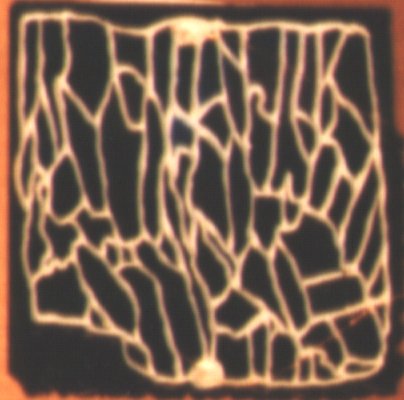
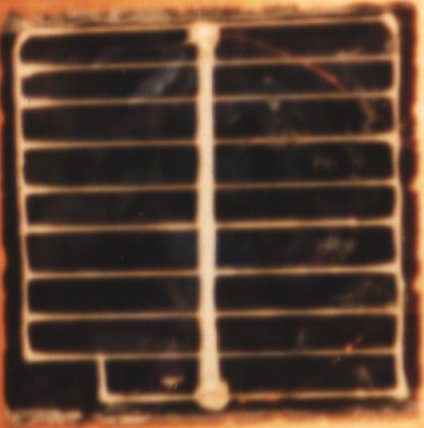
solar cells is shown in Fig.1 as a high contrast black and white picture
in order to illustrate the difference of the two front contact grids. Metallised
areas appear white whereas the active AR coated area appears to be black.
Some of the cell pairs were contaminated with well known minority carrier
lifetime killers such as iron prior to the diffusion of the p/n-junction.
This was done to ensure to a high degree that the differences in the finally
measured solar cell and diode parameters do not depend on occasional fluctuations
of the local minority carrier diffusion length within the grains in the
two cells. All our samples were prepared without any grain boundary passivation.
Current - voltage measurements in the dark as well as under illumination
were made on a series of 20 pairs of solar cells. This was done by the
use of a Keithley 224 current source which is capable to act as a current
sink for currents below 100 mA. Due to this limitation the I(V) curves
under illumination were performed using a tungsten halogen lamp with a
slightly reduced light intensity compared to simulated AM 1 irradiation.
Both, light intensity and temperature were kept constant during the measurements
of all samples. Some selected sample pairs were scanned with a light beam
at a wavelength of the emitted light of 940 nm. The induced current was
recorded as a function of the lateral location of the incident light on
the solar cell.
Fig. 1: Picture of a pair of solar cells. The front metal grid appears
bright whereas the active cell area is shown dark. On the left a test cell
with contacts along the grain boundaries and on the right a cell with a
conventional grid structure is displayed.
3. RESULTS
Using a DC equivalent circuit model the current - voltage curve in the
dark can be used to determine the diode parameter given by equation 1 [4]:
(Eq. 1)
i = i01 [exp((q(V-RSi)/(2kBT))-1]
+ i02 [exp((q(V-RSi)/(kBT))-1] + GSH
(V-RSi)
In the above equation q is the elementary charge and kB the
Boltzmann constant. The first term on the right side
of Eq.1 is due to the recombination current induced by deep recombination
centres within the depletion region of
the p/n-junction. The second term describes the current contribution
arising from the diffusion current determined
by the dopant concentration on each side of the p/n- junction. The
last part contributes in an ohmic way to the
total current and is characterized by the shunt conductance, GSH.
The expression V-RSi takes into account the
voltage drop across the series resistance, RS. Under illumination
eq.1 describes the internal current losses from
a constant light generated current, iL:
(Eq. 2)
itot(V)= iL - i(V)
The shunt conductance was determined from the first derivative of the
i(V) curve in the dark at V=0. As can be seen from eq.1 the series resistance
will dominate the i(V) curve at high current values. Above current densities
of approximately 10 mAcm-2 our i(V) curves nearly are linear
and RS was determined from the slope. In order to keep the temperature
constant at high current densities
the measurements were carried out with pulsed current. Correcting the
measured i(V) curve for GSH and RS the two parameters,
i01 and i02, characterizing the recombination and
the diffusion current respectively were obtained from a semilogarithmic
plot of i(V) for V=0. The i(V) curves taken under illumination were used
to obtain the short circuit current density, iSC, at V=0, the
open circuit
voltage, VOC, at i=0. From the plot of P(V), where P = i.V
the maximal power output, Pmax = imax.Vmax,
was determined and used to calculate the curve fill factor, CFF = Pmax
/ (iSC . VOC), and the load resistance, Rload
= Vmax / Imax. A comparison of all our cell pairs
shows that for more than 2/3 of the pairs, RS and CFF of the
cells which have a front contact grid along the grain boundaries are clearly
improved compared to the reference samples. The short circuit current however
was found to be reduced. This may be very likely due to the fact that our
test cells have larger shaded areas due to the front contact grid than
the reference cells. The shaded area of the test cells was typically 5
per cent larger than the one of the reference cells. With the exception
of the shunt conductance all other parameters were found to be unaffected
from the method of the front contact metallisation. This can be considered
a proof or the relevance of the statistical data evaluation since there
cannot be any influence of the front metallisation expected on recombination
current, diffusion current or open circuit voltage. These parameters are
essentially determined by the p/n-junction characteristics. For most of
the pairs the shunt conductance too was about equal however there have
been some samples of test cells which exhibit up to 2 orders of magnitude
increased values of GSH. It appears to be likely that during
the firing of the silver ink silver particles can penetrate more easily
along grain boundaries across the p/n-junction than they do within the
grains thus shunting the diode. The overall mean values and standard deviation
of the diode and solar cell parameters are summarized in table 1. The mean
value of the load resistance for the test cells was 8.2 Ohm ± 16
per cent whereas for the reference cells a value of 7.8 Ohm ± 51
per cent was found. The much smaller standard deviation for the test cells
indicates that the influence of individual grains on the overall solar
cell output is clearly reduced.
Table 1: Mean values and standard deviations - in parenthesis - of diode
and solar cell parameters.
|
j01 (µA)
|
j02 (10-11 A)
|
GSH (mS)
|
RS (Ohm)
|
CFF (-)
|
iSC (mA)
|
VOC (V)
|
| Test cell |
1,0 (0,5)
|
8,6 (2,8)
|
0,62 (0,48)
|
0,43 (0,06)
|
0,72 (0,09)
|
63,9 (5,9)
|
0,520 (0,013)
|
| Reference cell |
1,1 (0,7)
|
8,1 (2,8)
|
0,30 (0,08)
|
0,52 (0,17)
|
0,68 (0,13)
|
73,1 (6,6)
|
0,520 (0,015)
|
4. CONCLUSIONS
The method to form the front contact grid along the grain boundaries of
a poly silicon solar cell has been found to be advantageous in order to
reduce the series resistance of the device. A reduction of more than 20
per cent was observed. As a consequence we have found an improvement of
typically more than 5 per cent of the curve fill factor of our test cells
compared to the reference cells. Against our expectation the short circuit
current measured on the test cells exhibit smaller values than the ones
observed on the reference cells. This can be explained by the fact that
the top surface area of the reference cells was less shaded by the front
metal grid than it was on the test devices. An improved method for the
application of the front metal grid along grain boundaries
is under progress. Besides the observed improvement of R S and CFF
a clearly reduced variation of the individual solar cell parameters of
the test cells was found. This could become important for the solar cell
array fabrication since it bears the potential for improved module efficiency.
5. ACKNOWLEDGMENT
One of us (J.S.) would like to thank Prof. J. Nijs of IMEC (Leuven, Belgium)
for his hospitality and for permitting insight into their methods during
a visit.
REFERENCES
[1] W.Schmidt, G.Friedrich, K.D.Rasch, "Electrical properties of grain
boundaries in nonsingle crystalline silicon solar cells", Proc. of the
3 rd EC Photovoltaic Solar Energy Conf, Cannes, 664, (1980)
[2] D.S.Ginley, R.P.Hellmer, Journal of Applied Physics, 58, 871, (1985).
[3] S.Narayanan, S.R.Wenham, M.A.Green, Applied Physics Letters, 48,
873, (1986).
[4] V.Schlosser, IEEE Transactions on Electron Devices, 31, 610, (1984).
Changes 21.Mar.2001 by J.Summhammer