| Research on Silicon Solar Cells at the Atominstitut |
|
| We find a REAL EFFICIENY IMPROVEMENT |
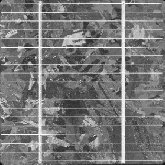
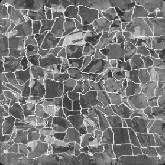
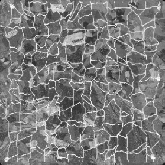
| About 90 multicrystalline silicon wafers of size 100x100 mm² were
taken in adjacent triples of the original ingot and produced into cells
as shown below. The first cell of each triple got a standard H-pattern
as front metal grid, the second one a grid that followed largely the grain
boundaries, and the third one got the same grid but rotated by 90°,
so that it hardly ran over grain boundaries. The grid was applied by automated
writing of screen printing paste. Averaged power outputs under standard
conditions are shown below the cells, where the power output of the cells
with standard H-pattern was defined as 100%.
(Work supported by Austrian Science Foundation (Fonds zur Förderung der Wissenschaftlichen Forschung, Projects P14432 and P16055.) |
| RECENT RESULTS . . . |
|
|
|
| 1. Standard H-pattern | 2. Finger grid mostly along grain boundaries ("on-grid") | 3. Same finger grid as 2, but rotated 90° ("off-grid") |
| Max. power (defined): 100 | Max. power: 103.4 | Max. power: 99.4 |
|
 |
 |
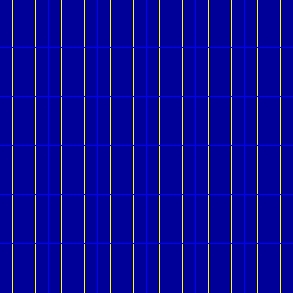
| Standard type of photovoltaic module currently used for roof and facade integration in buildings. 36 cells. Size: 80 x 80 cm². | New type of photovoltaic module. The busbars
have artistic shape. Facades and roofs will look more interesting.
Power output is virtually the same as that of the standard module on the
left. 36 cells. Size 80 x 80 cm².
Such modules will soon be available from the company POWERQUANT. |
8.Aug.2003 J.Summhammer